
Cloud Hosting
Utho Asks India to Book B300 GPUs Before They Arrive
Utho Cloud is taking one- to three-year rupee bookings for NVIDIA B300 GPUs due in February 2027, before it has said how many chips it will rack.

Utho Cloud opened reservations on 19 October 2026 for NVIDIA B300 GPUs hosted in India, with the chips due in February 2027. Indian AI companies, research labs and enterprises can lock one-, two- or three-year rupee terms, and capacity is handed out in the order bookings arrive.
The wager sits in that gap. NVIDIA already sells the board. A listed Indian GPU cloud already runs Blackwell. Utho is selling a place in line, a rupee invoice and a date, without saying how many B300s will land.
Reservations Open for a February Deployment
Utho, the Noida-based firm that brands itself as India’s sovereign cloud, put the B300 on a committed-term sheet rather than an hourly menu. The 19 October statement invites AI companies, research institutions and enterprises to reserve dedicated capacity ahead of the February 2027 deployment. Availability follows reservation order.
The same week, Utho’s GPU catalogue already carried an early-access B300 listing with custom pricing, showing 16 vCPUs, 128 GB of system RAM and 288 GB of GPU memory. That page is a quote form. The dated promise is still February 2027.
WHAT WE KNOW
- The window: Reservations opened on 19 October 2026 for a February 2027 India deployment.
- The terms: Customers can commit for one, two or three years, with allocation in reservation order.
- The wrapper: Utho is selling India-hosted racks, rupee invoices and round-the-clock engineering support.
- The installed base: The broader cloud platform serves more than 51,000 customers, including over 3,500 B2B clients.
WHAT IS UNCONFIRMED
- The count: Utho has not said how many B300 GPUs will be in the February 2027 batch, or how that batch sits inside its 10,000-GPU plan.
- The rupee rate: No public hourly or monthly B300 price has been posted; the live listing is custom pricing.
- The deposit: The announcement does not spell out prepayment, cancellation or what happens if the pallets slip.
Utho’s own timeline page also frames the 2026 AI push as reservations for B300 DGX and HGX nodes, alongside GB300 and H200. That is a form-factor claim, not a headcount.
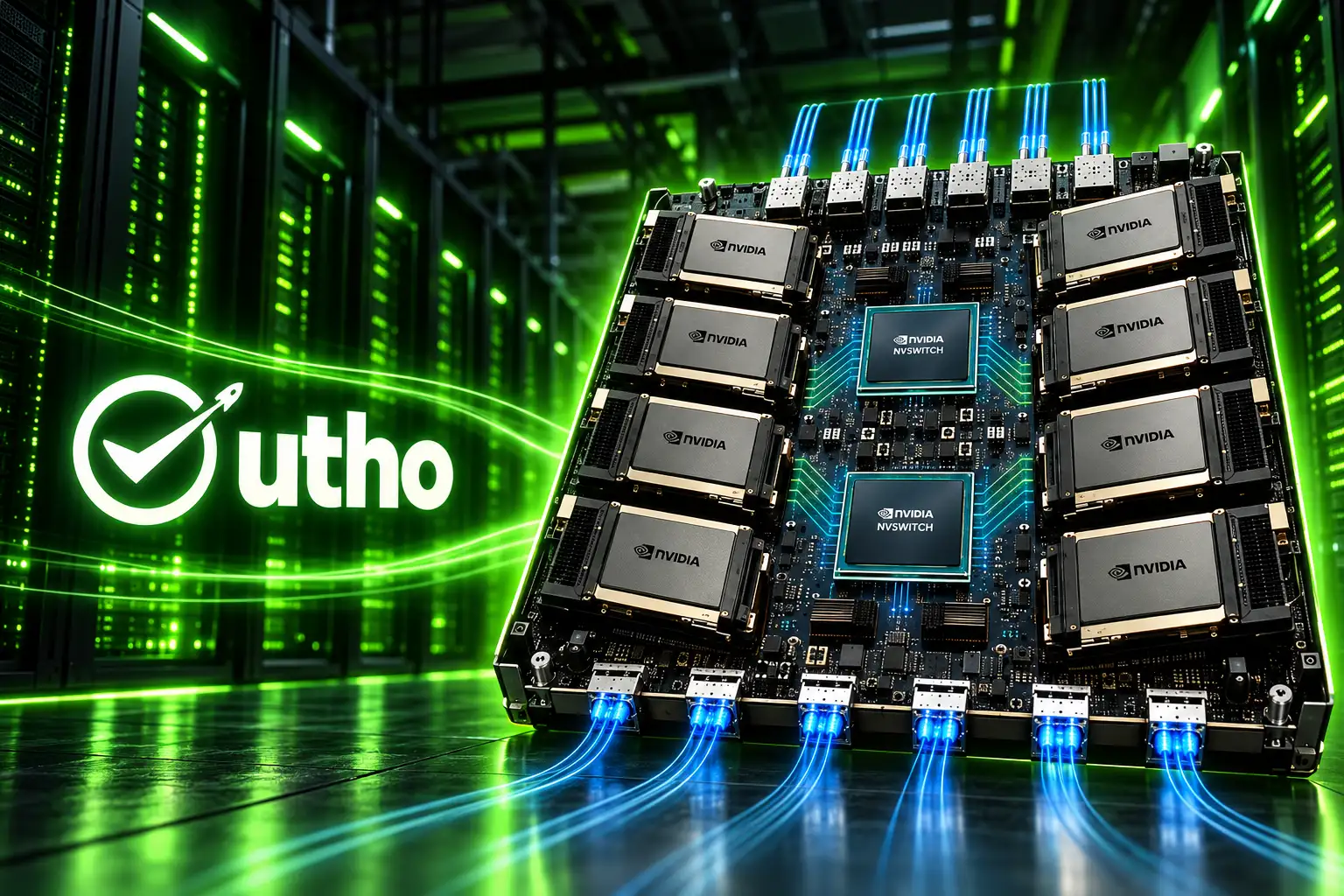
What a B300 Node Puts on the Floor
The B300 is NVIDIA’s Blackwell Ultra data-center GPU. Utho is marketing it for large language model training, inference, advanced reasoning and AI agents. The memory figure both Utho and NVIDIA publish is 288 GB of HBM3e per card, which is the number that decides whether a model stays on the GPU or spills to slower memory.
NVIDIA’s HGX platform page lists HGX B300 as shipping now, in an eight-GPU Blackwell Ultra SXM board. An eight-GPU HGX B300 node carries 288GB of HBM3e memory per GPU, or 2.30 TB across the node, with up to 8 TB/s of memory bandwidth on the B300 SXM. The board is specified at up to 144 petaflops, with 1.8 TB/s of GPU-to-GPU NVLink, 14.4 TB/s of aggregate NVLink, and ConnectX-8 networking at 800 Gb/s per GPU.
MEMORY ON ONE SXM CARD
| GPU | Architecture | HBM3e per GPU | HBM3e per 8-GPU node |
|---|---|---|---|
| H200 SXM | Hopper | 141 GB | 1.1 TB |
| B200 SXM | Blackwell | 180 GB | 1.44 TB |
| B300 SXM | Blackwell Ultra | 288 GB | 2.30 TB |
That 288 GB is 60% more memory than the 180 GB on a B200, which is why the Ultra board is being sold for long-context inference and fatter training shards, not as a modest step up from Hopper. Public cloud price lists compiled on 19 October 2026 already put on-demand B300 time between $8.44 and $17.80 per GPU-hour outside India. Utho is not matching that menu. It is asking Indian buyers to wait until February and then pay in rupees on a committed term.
The 10,000-GPU Shopping List Came First
The B300 booking sits on top of a wider pledge. In July 2026, founder and CEO Manoj Dhanda said Utho would buy 10,000 GPUs over the next two years, spread across seven to eight quarters, and would later add AMD. He said the NVIDIA tranche would start with enterprise parts already in the market, not with Blackwell Ultra.
THE JULY 2026 NVIDIA LIST
- H200: Hopper training card, later listed on Utho from ₹1,79,995 a month.
- H100: The volume Hopper part for mid-size training and inference.
- A100: The older Ampere card still used for cheaper fine-tunes.
- RTX Pro 6000 Blackwell: Workstation-class Blackwell, listed from ₹1,18,000 a month.
- L4: Inference accelerator, the small end of the same shopping list.
Dhanda said the mix was meant for mid-level inference and training, with pricing “up to 60% below hyperscaler GPU rates, with transparent terms.” Utho still uses that “up to 60%” line on its GPU pages. It has not shown the rupee math on a B300.
UTHO’S GPU CLOCK
- 2010: Starts as a web hosting company, later known as Microhost.
- 2018: Launches a public cloud platform out of that hosting business.
- 2023: Rebrands the cloud as Utho.
- July 2026: Announces a 10,000-GPU buy over seven to eight quarters, led by H200, H100, A100, RTX Pro 6000 Blackwell and L4.
- 19 October 2026: Opens B300 reservations for a February 2027 deployment.
The leap is the SKU. A plan built around Hopper, L4 and a workstation Blackwell is now taking multi-year bookings for the flagship Ultra board. The 10,000 figure is a purchase target. It is not a live fleet, and it is not a B300 headcount.
Blackwell Already Has a Home in India
The scarcity story only holds if nobody in India can already rent Blackwell. That is not the case. E2E Networks, one of the country’s early NVIDIA Cloud Partners, said on 1 June 2026 that it had brought up an NVIDIA-certified HGX B200 cluster in India, built on NVIDIA’s reference design with InfiniBand rather than a one-off rack.
With the deployment of NVIDIA B200 infrastructure, E2E is taking another significant step toward building one of the most advanced AI cloud platforms in India.
Tarun Dua, E2E Networks, 1 June 2026
E2E’s own B200 product page prices that generation from ₹759.05 an hour. Other Indian operators, including Yotta, already publish rupee rates for H100, H200 and B200. The local market Utho is entering is not an empty waiting room. It is a set of firms that already bill Blackwell-class time in rupees, on hardware that is plugged in.
What Utho can still sell is the next board, on India-hosted metal, with a term that starts before the crate is opened. That is a different product from a B200 you can boot this afternoon.
Rupee Bills Meet a Permissive Privacy Law
Utho’s pitch pairs the chip with two Indian wrappers: invoices in rupees, and data that stays in Indian data centers. The rupee part is concrete. A three-year GPU bill in dollars moves with the exchange rate; a rupee contract does not. For a finance or health team that budgets in INR, that is the product, even if the silicon is the same board AWS sells in Virginia.
The legal wrapper is thinner than the marketing. The Digital Personal Data Protection Act, 2023 does not, on its face, force every training run onto Indian GPUs. Section 16 lets the Central Government restrict transfers of personal data to notified countries. Until a country is named, the default is that transfers are allowed, while other Indian laws, including RBI rules for banks, can still be stricter.
Utho’s trust pages go further than the statute. The company says it is 100% Indian-owned, that customer compute, storage and backups stay in Indian data centers, and that it hosts on Tier III and IV sites run by Yotta and NTT. It lists SOC 2 Type II, ISO 27017, ISO 27018 and PCI-DSS. Those are contract and certification choices. They matter for government, BFSI and health buyers who write residency into the purchase order. They are not a universal DPDP lock that makes a Mumbai B300 the only legal place to fine-tune a model on public weights.
The honest split is this. Rupee billing removes FX noise. India hosting satisfies buyers whose own regulators or boards already demand it. The Act’s Section 16 is a negative list, not a rack map.
First in Line Still Waits for the Pallet
Utho’s announcement sells “queue-free support” in the same breath as a reservation that is itself a queue. Those are different lines. Support means 24/7 engineers, which the company contrasts with ticket bots. Capacity means first-come allocation for a board that is not in the rack until February 2027.
India’s AI ecosystem is moving beyond experimentation. Enterprises, startups and research teams need reliable access to advanced computing to build, train and deploy AI applications at scale. By opening reservations for NVIDIA B300 capacity in India, we want to give businesses greater certainty around access, costs and data location. Our broader investment in GPU infrastructure is focused on making powerful AI computing more accessible to Indian organisations.
Manoj Dhanda, Founder and CEO, Utho Cloud
Certainty of access is exactly what a reservation sells, and it is also what it cannot prove until the serial numbers show up. NVIDIA’s own HGX page already treats B300 as a shipping part. The lag Utho is asking customers to fund is the India install, the power and cooling, and the time to get Ultra boards into a Noida- or Mumbai-facing cluster, not the invention of the chip.
Utho names five regions on its public map: Mumbai, Delhi NCR, Bangalore, Frankfurt and Los Angeles. The B300 offer is the India-hosted slice of that network. Teams that only need FLOPS, and can tolerate a dollar invoice, already have other doors. Teams that need the FLOPS, the rupee bill and the Indian jurisdiction are the ones this form is written for.
Custom Quotes Hide the Hourly Rate
Utho’s live GPU menu is frank about older cards and quiet about Ultra. The B300 row is early access and custom pricing. The published starting prices sit on the generation below.
PUBLISHED UTHO GPU STARTING PRICES
- RTX Pro 6000 Blackwell: From ₹1,18,000 a month on Utho’s GPU landing page.
- H200: From ₹1,79,995 a month on the same page.
- B300: 16 vCPU, 128 GB RAM, 288 GB VRAM, early access, price on request.
A buyer who wants a number they can put in a spreadsheet can already read $8.44 to $17.80 per GPU-hour on public B300 lists abroad, or ₹759.05 an hour for a live Indian B200. A buyer who wants Utho’s Ultra board has to ask, then sign a one-, two- or three-year term, then wait until February 2027 to see whether the allocation they reserved is the allocation they receive.
Utho has not published how many B300 GPUs will sit in those racks, or what a reserved hour will cost in rupees. Those answers arrive with the quotes, and then with the pallets.

Utho Asks India to Book B300 GPUs Before They Arrive

FirstVDS Disk Theft Exposes a Live VMmanager Flaw

Rank Math PRO Joined a 2026 Pattern of Paid Plugin Backdoors

Yandex Cloud Bots Moved to Selectel After the Strikes

Elementor Pro’s Form Bug Left Hosts Holding the Cleanup

GoDaddy Lets AI Agents Run Hosting, Email and Stores

Titan Puts a $3 Inbox Beside Google on Squarespace
Yandex Cloud Bots Moved to Selectel After the Strikes
Rank Math PRO Joined a 2026 Pattern of Paid Plugin Backdoors
FirstVDS Disk Theft Exposes a Live VMmanager Flaw
-
 AI4 days ago
GoDaddy Lets AI Agents Run Hosting, Email and Stores
-
 Email Hosting1 week ago
Titan Puts a $3 Inbox Beside Google on Squarespace
-
 Cloud Hosting3 days ago
Yandex Cloud Bots Moved to Selectel After the Strikes
-
 NEWS2 days ago
Rank Math PRO Joined a 2026 Pattern of Paid Plugin Backdoors
-
 NEWS1 day ago
FirstVDS Disk Theft Exposes a Live VMmanager Flaw
-

 Email Hosting7 days ago
Windows Updates Cap RPC Calls and Stall Exchange Mail
-
 NAS6 days ago
Sandisk NAS 800 Speed Outruns the Boxes It Targets
-

 AI6 days ago
GreenGeeks Bets $4.95 Node.js Hosting on AI Apps