
NAS
Sandisk NAS 800 Speed Outruns the Boxes It Targets
Sandisk’s NAS 800 posts 14,900 MB/s and 14 PBW, but Synology lists and 2.5GbE links leave most of that speed unused.

Sandisk’s NAS 800 NVMe SSD rates its 7.68TB model at 14 PBW and 14,900 MB/s sequential read. Most of the network boxes sold to the same buyers still move files over 2.5GbE, a link that tops out at 312.5 MB/s.
Sandisk announced both NAS SSD families on August 20, 2026, and put them on Sandisk.com and select retailers in September, with more international listings appearing through October. The slower SATA sibling is the one that slides into the bays people already own.
Two Lines for Two Different NAS Generations
The NAS 600 is a 2.5-inch, 7mm SATA III drive with Sandisk TLC 3D NAND, an SLC cache, and no DRAM. Capacities run 500GB, 1TB, 2TB, and 4TB, with sequential reads of 560 MB/s across the line and sequential writes of 505 MB/s on the 500GB SKU up to 520 MB/s on the 4TB SKU.
The NAS 800 is an M.2 2280 PCIe 5.0 x4 NVMe 2.0 stick with Sandisk TLC 3D CBA NAND, DRAM, and an SLC cache. Capacities run 960GB, 1.92TB, 3.84TB, and 7.68TB. Sequential read is 14,900 MB/s on every SKU. Sequential write peaks at 13,200 MB/s on the 1.92TB model and sits at 13,000 MB/s on the 7.68TB model.
Random I/O, the figure that matters for VMs and many small files, does not peak on the largest stick. The 1.92TB and 3.84TB models reach 2.3 million random read IOPS. Random write reaches 2.0 million IOPS on the 3.84TB model and 2.1 million IOPS on the 7.68TB model. The 960GB drive is the slowest of the four, at 1.6 million / 0.8 million IOPS.
NAS 600 4TB VS NAS 800 7.68TB
| Spec | NAS 600 4TB | NAS 800 7.68TB |
|---|---|---|
| Interface | SATA III 6 Gbps | PCIe 5.0 x4 NVMe 2.0 |
| Form | 2.5-inch, 7mm | M.2 2280-D5-M |
| DRAM | No | Yes |
| Seq. read / write | 560 / 520 MB/s | 14,900 / 13,000 MB/s |
| Random read / write | 86K / 77K IOPS | 2.2M / 2.1M IOPS |
| Endurance | 2,500 TBW | 14,000 TBW |
| MTTF | 2.25M hours | 1.75M hours |
| Active power (read) | 1.2 W | 6.9 W |
| MSRP | $999.99 | $2,199.99 |
The SATA drive actually carries the higher MTTF, 2.25 million hours against 1.75 million hours on the NVMe line. Both carry a 5-year limited warranty. Sandisk’s press materials frame the pair as storage for prosumers and small businesses running hybrid or all-flash NAS, not as a laptop upgrade with a new label.
The new SANDISK NAS 600 SATA SSD and SANDISK NAS 800 NVMe SSD are engineered to deliver the reliable, consistent performance, high-endurance, and scalability required for today’s demanding NAS workloads.
Sandisk, August 20, 2026 press release
US list prices start at $179.99 for the 500GB NAS 600 and $309.99 for the 960GB NAS 800. The 1TB, 2TB, and 4TB SATA SKUs list at $279.99, $499.99, and $999.99. The 1.92TB, 3.84TB, and 7.68TB NVMe SKUs list at $559.99, $1,099.99, and $2,199.99.
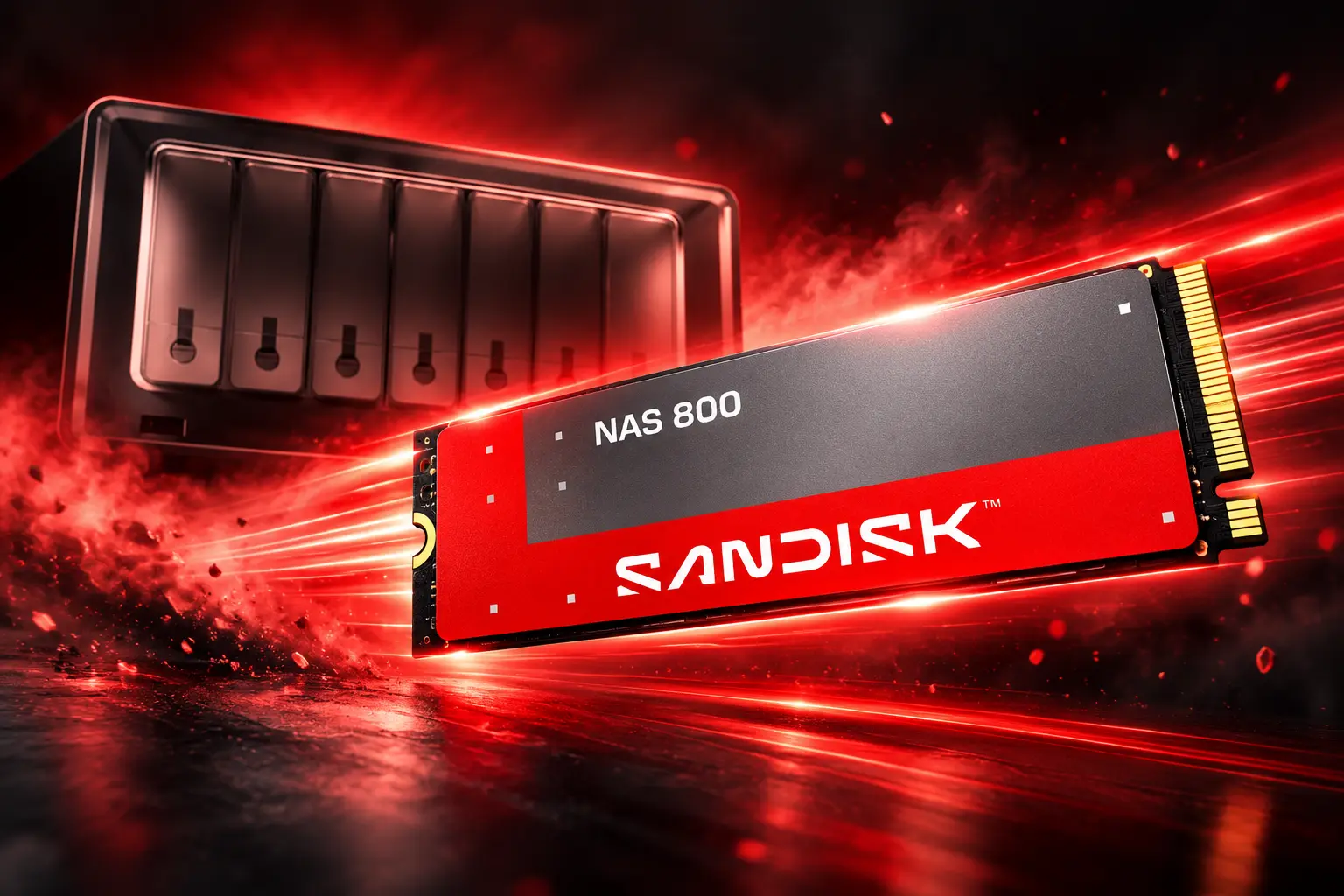
14,900 MB/s Hits a 2.5GbE Ceiling
A single NAS 800 can fill a PCIe 5.0 x4 link in a lab. The moment that data has to leave the box, the network sets the cap, and most home and small-office NAS units still ship with 2.5GbE as the fast port.
WHERE THE RATED SPEED GOES
- 2.5GbE port: Theoretical payload is 312.5 MB/s, about the same order as the NAS 600’s 560 MB/s SATA ceiling after protocol overhead.
- 10GbE port: Theoretical payload is 1,250 MB/s, still far below 14,900 MB/s.
- 25GbE port: Theoretical payload is 3,125 MB/s, enough to feel fast on large copies and still well short of the sticker.
- NAS 800 read rating: 14,900 MB/s, which only shows up inside the chassis for local VMs, containers, and cache hits.
That is why the 14,900 MB/s figure keeps getting treated as a desktop SSD number wearing NAS clothing. On a typical 2.5GbE Synology or QNAP box the extra PCIe 5.0 bandwidth never leaves the enclosure. Some midrange QNAP SSD slots are narrower still, Gen3 x1 in the E1.S bay on models such as the TS-h665, with a theoretical cap around 1 GB/s.
The speed is not wasted in every setup. A DIY all-flash NAS with a fast CPU, enough PCIe lanes, and 25GbE or faster can use the random I/O for VMs sitting on the box. That is a smaller slice of the audience Sandisk named in the launch note than the person replacing a 2.5-inch tray in a four-bay that has been on the shelf since 2022.
Synology Still Lists Only Its Own NVMe SSDs
Sandisk’s data sheet says the NAS 800 was tested with many leading NAS systems that take M.2 2280 cards, and that it is compatible with PCIe 5.0, 4.0, and 3.0 slots. It does not name Synology, QNAP, or Asustor, and it does not publish a blessed compatibility list.
Synology’s own 2025 and later M.2 cache rules are stricter than a generic PCIe socket. On DSM 7.3, Plus-series boxes from the 2025 generation onward refuse unlisted M.2 NVMe drives for a new storage pool and for cache. Unlisted 2.5-inch SATA SSDs are treated more loosely on DS Plus, Value, and J models.
To ensure system reliability, only M.2 NVMe SSDs meeting strict performance, endurance, and thermal management requirements are supported for creating storage pools and caches.
Synology Knowledge Center, drive compatibility policies for DSM 7.3
WHAT A 2025 PLUS BOX WILL ACCEPT
- Listed M.2 NVMe: Allowed for a new pool, for cache, and for migration.
- Unlisted M.2 NVMe: Blocked for a new pool and for cache on 2025 and later Plus models.
- 2.5-inch SATA SSD: Any SATA SSD can be used in DS Plus, Value, and J bays, listed or not.
- DS725+ M.2 list: The DS725+ verified M.2 SSD list names Synology SNV5420, SNV3410, and SNV3400 SKUs, with the SNV5420 topping out at 1.6TB.
A 7.68TB NAS 800 therefore sits outside the official M.2 path on a current Plus-series Synology, while a 4TB NAS 600 can occupy a SATA bay on the same brand without waiting for a firmware blessing. Homelab builders on Unraid, TrueNAS, or a QNAP that still lets third-party NVMe form a pool are in a different boat. They can install the stick. They still have to feed it.
The SATA Drive That Fits Yesterday’s Bays
Enclosure refresh cycles run five to seven years. Drive refresh cycles are shorter. That gap is the NAS 600’s whole job. It drops into a 2.5-inch or 7mm bay, including 3.5-inch trays that already accept 2.5-inch SSDs, and it does it at 1.1 W to 1.2 W average active power.
Write endurance on the SATA line is 350 TBW at 500GB, 600 TBW at 1TB, 1,300 TBW at 2TB, and 2,500 TBW at 4TB. Random writes reach 77K IOPS on the 4TB model. Those are not Gen5 numbers. They are better than a dying laptop SSD pressed into RAID duty, and they match the bus the bay already has.
The missing DRAM is the trade. Desktop NAS firmware does a lot of small random writes during scrubbing, snapshots, and Docker metadata. A DRAM-less controller with an SLC cache will look fine in a burst and then fall back. For a quiet file share and backup target, that is often acceptable. For a dozen VMs on SATA, it is the reason some buyers still pay for a DRAM NAS SSD even when the bay cannot take NVMe.
Japan listings in mid-October already showed three-drive purchase caps on the NAS 600 and ship dates into early December, a sign that NAND supply is tight enough to ration a SATA SKU, not only the halo 7.68TB stick. UK storefronts on October 19 listed the 4TB NAS 600 at £891.99 and the 1.92TB NAS 800 at £498.99. China storefronts on October 12 opened the SATA line at 2,599 yuan and the NVMe line at 3,999 yuan, with the 7.68TB model at 26,999 yuan.
Sandisk Rated 14 PBW on a Client Workload
Fourteen petabytes written equals 14,000 terabytes written. Sandisk’s footnote is the part that belongs next to the headline: TBW is calculated with the JEDEC client workload (JESD219) and varies by capacity. That is the same class of test used for client SSDs, not an enterprise mixed-workload rating. It does not make the number ornamental. It does mean 14 PBW is not a drop-in substitute for a data-center DWPD figure from a U.2 or E3.S product.
Spread 14,000 TBW across five years and 1,825 days and the 7.68TB stick is rated for about 7.67 TB of writes per day, or one full drive write per day. The 960GB, 1.92TB, and 3.84TB SKUs land at the same 1.0 DWPD once you divide 14,000 TBW on the 7.68TB model’s sister ratings of 1,750, 3,500, and 7,000 TBW by capacity and the same 1,825-day window.
The 4TB NAS 600 at 2,500 TBW is about 0.34 DWPD over five years. WD’s older Red SN700 4TB, still a common NAS NVMe cache drive, is rated at 5,100 TBW, about 0.70 DWPD, with PCIe Gen3 sequential reads of 3,400 MB/s and writes of 3,100 MB/s. The NAS 800 3.84TB stick at 7,000 TBW clears that write budget and jumps two PCIe generations. The NAS 600 does not.
FIVE-YEAR WRITE BUDGETS
| Drive | Capacity | TBW | Approx. DWPD | Interface |
|---|---|---|---|---|
| Sandisk NAS 800 | 7.68TB | 14,000 | 1.0 | PCIe 5.0 x4 |
| Sandisk NAS 800 | 3.84TB | 7,000 | 1.0 | PCIe 5.0 x4 |
| WD Red SN700 | 4TB | 5,100 | 0.70 | PCIe Gen3 x4 |
| Sandisk NAS 600 | 4TB | 2,500 | 0.34 | SATA III |
Hands-on testing of the 1.92TB NAS 800 described strong sustained writes and low 4K latency, with the usual caveat that the sticker price is the brake. NAND pricing makes that premium harder to swallow than it was when client 2TB drives were cheap. Endurance is still the spec a NAS buyer cannot fake with a sale-bin SSD, because a worn-out stick in RAID costs more than the extra dollars on the invoice.
Heat and Height Catch Up With the Flagship
Average read power on the NAS 800 runs 6 W on the 960GB SKU to 6.9 W on the 7.68TB SKU. Average write power matches that band, 5.6 W to 6.9 W. The NAS 600 sits at 1.1 W to 1.2 W active, with a 4.1 W max write on the 4TB model. Two NAS 800 sticks in a compact Plus-series chassis are a thermal load those small M.2 heatsinks were not designed around when the bay was meant for a 3,400 MB/s cache drive.
US list price on the 7.68TB stick is $2,199.99, about $286 per terabyte. The 4TB NAS 600 lists at $999.99, $250 per terabyte. The SATA line is the cheaper way to buy write budget only if the enclosure has no M.2 slot you are allowed to use.
THE NAS SSD ROLLOUT
- August 20, 2026: Sandisk announces the NAS 600 and NAS 800, with September sales on Sandisk.com and select retailers.
- September 2026: US list pricing is live, from $179.99 and $309.99 at the entry SKUs.
- October 12, 2026: China listings open both lines, from 2,599 yuan on the NAS 600 and 3,999 yuan on the NAS 800.
- October 19, 2026: UK listings show the 4TB NAS 600 at £891.99 and the 1.92TB NAS 800 at £498.99.
Sandisk is still filling channels region by region rather than finishing a single global day-one dump. Independent testers who already had the 1.92TB stick in October treated it as a fast, durable, expensive NAS workhorse. That verdict fits a DIY all-flash build with the lanes and the network to match. It fits much less well as a $2,199.99 drop-in for a 2.5GbE box whose M.2 list still stops at a 1.6TB Synology part.
For the large installed base of two-bay and four-bay units, the quieter number is still 560 MB/s and 2,500 TBW, in a 7mm tray that slides into a bay that has been there for years.
Frequently Asked Questions
Can the NAS 800 Run in a PCIe 4.0 NAS?
Yes. Sandisk’s data sheet lists backward compatibility with PCIe 5.0 x2 and x1, PCIe 4.0 x4/x2/x1, and PCIe 3.0 x4/x2/x1, so a Gen4 M.2 slot will talk to the drive at Gen4 rates. The 14,900 MB/s sequential read rating assumes a PCIe 5.0 x4 link and will not show up on a Gen4 x4 bay, which tops out near half that bandwidth before the NAS CPU and network take their own cuts.
Will the 7.68TB Model Fit Every M.2 Slot?
Not always. Capacities from 960GB through 3.84TB use the M.2 2280-S3-M profile at 2.38mm tall. The 7.68TB SKU uses the M.2 2280-D5-M profile at 3.88mm tall, 1.50mm thicker, because it is double-sided. Tight heatsink clamps and some low-profile NAS covers sized for a 2.38mm stick can fail to close on the 3.88mm card even when the slot is electrically correct.
Does the Five-Year Warranty Cover the Full Write Budget?
The limited warranty runs five years or until the drive hits its TBW rating, whichever comes first, with region details on Sandisk’s support site. A 7.68TB NAS 800 that truly writes 7.67 TB every day will exhaust 14,000 TBW at the five-year mark. A lighter duty cycle can outlast the calendar term with spare write budget, and a heavier one can end the coverage early even if the stick still boots.
Does the NAS 600 Include DRAM?
No. The NAS 600 data sheet lists DRAM as no and SLC cache as yes on every capacity, which is why burst writes look healthy and long random-write stretches depend on the cache remaining effective. The NAS 800 lists DRAM as yes on all four SKUs, along with TCG OPAL 2.0 hardware encryption that needs motherboard BIOS support or third-party software before it turns on.

Utho Asks India to Book B300 GPUs Before They Arrive

FirstVDS Disk Theft Exposes a Live VMmanager Flaw

Rank Math PRO Joined a 2026 Pattern of Paid Plugin Backdoors

Yandex Cloud Bots Moved to Selectel After the Strikes

Elementor Pro’s Form Bug Left Hosts Holding the Cleanup

GoDaddy Lets AI Agents Run Hosting, Email and Stores

Titan Puts a $3 Inbox Beside Google on Squarespace

GreenGeeks Bets $4.95 Node.js Hosting on AI Apps

Windows Updates Cap RPC Calls and Stall Exchange Mail

Minisforum S5 NAS Sells Silence at $599 Without Drives
-
 AI3 days ago
GoDaddy Lets AI Agents Run Hosting, Email and Stores
-
 Email Hosting6 days ago
Titan Puts a $3 Inbox Beside Google on Squarespace
-
 AI5 days ago
GreenGeeks Bets $4.95 Node.js Hosting on AI Apps
-
 Email Hosting6 days ago
Windows Updates Cap RPC Calls and Stall Exchange Mail
-
 NAS2 days ago
Minisforum S5 NAS Sells Silence at $599 Without Drives
-
 NEWS4 hours ago
FirstVDS Disk Theft Exposes a Live VMmanager Flaw
-
 NEWS1 day ago
Rank Math PRO Joined a 2026 Pattern of Paid Plugin Backdoors
-

 NEWS6 days ago
Converted PDFs Rank in AI Mode but Refresh Like Images