AI
GoDaddy Lets AI Agents Run Hosting, Email and Stores
GoDaddy opened hosting, email and commerce APIs so coding agents can take a working app live, with a person still approving the spend.

GoDaddy opened hosting, email and commerce APIs on October 15, 2026, so a coding agent can take a working app all the way to a live business.
The Developer Platform is free worldwide. You still pay for the domain, the hosting plan, the mailbox and the store that agent stands up.
The Last Mile After the Coding Agent
Hemanth Guntupalli, chief technology officer of platforms at GoDaddy, put the pitch in one line: the next businesses will be built differently, and GoDaddy wants to own everything after the code compiles. In the October 15 announcement he said AI can turn an idea into working software in minutes, and the company is building the stack that takes that software the rest of the way.
The next generation of businesses will be built differently. AI can turn an idea into working software in minutes, and we’re building the infrastructure that lets developers and AI agents take that software the rest of the way. From code to hosting, domains, email, and commerce, our customers can take their working application to a live business without breaking the flow.
Hemanth Guntupalli, chief technology officer of platforms, GoDaddy, October 15, 2026 announcement
That is a change in who actually clicks Buy. GoDaddy already holds over 80 million domain names for over 20 million customers, so the names, the DNS, the mail and the checkout already live in one account. The new work is letting a token drive that account from a terminal, a CI job or an agent session, instead of a person tabbing through the dashboard.
The company’s own engineering posts have treated agents as first-class users since July, not as a marketing add-on. A browser checkout stops an agent cold. Documented API calls do not.
Four API Families Share One Token
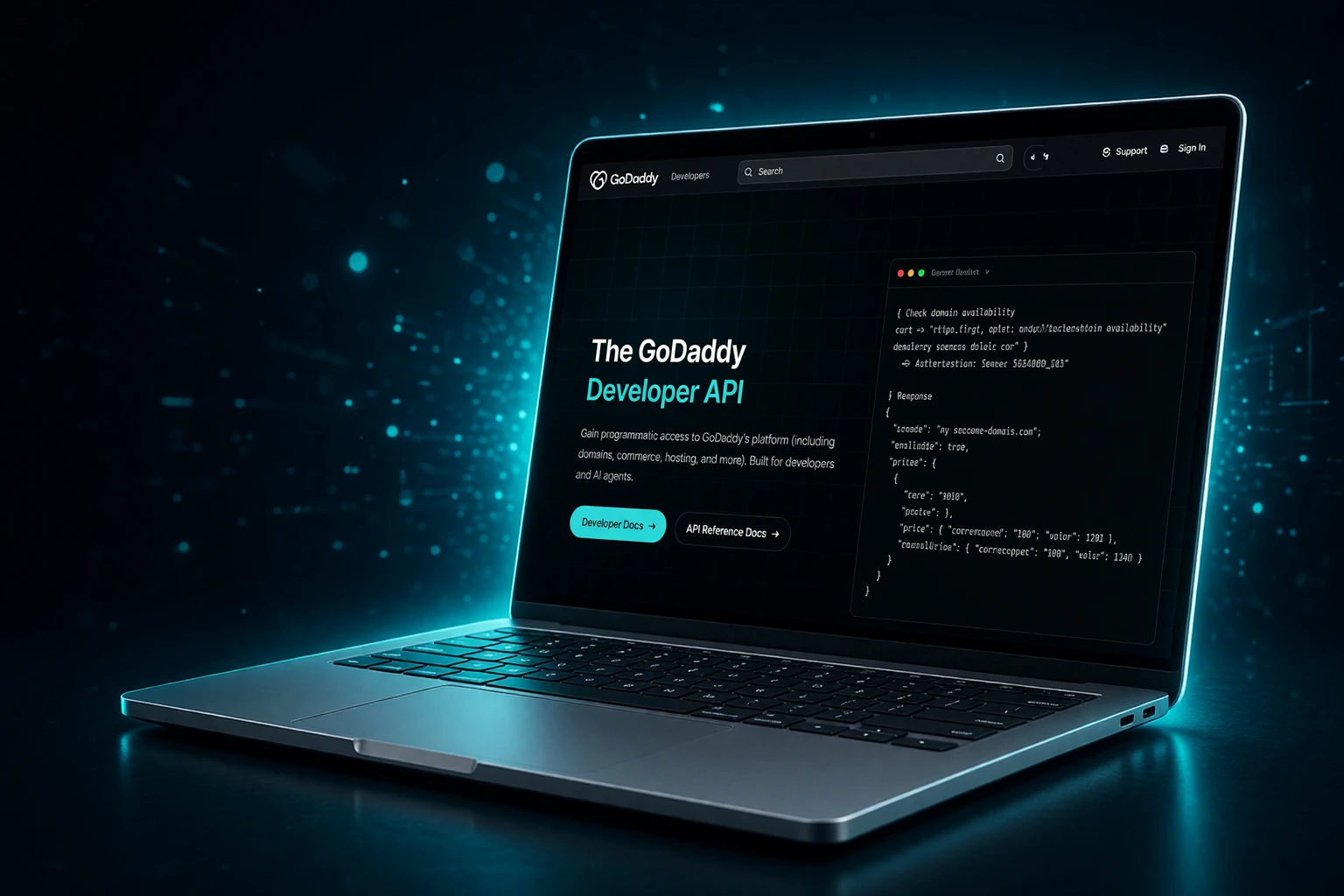
The October 15 release groups GoDaddy products into four API families that share one identity, one Personal Access Token model, one CLI named gddy, and one docs site. Guntupalli’s team says a developer can add product-specific scopes to that token and call REST or the CLI without opening a dashboard.
WHAT THE FOUR APIS ACTUALLY DO
| API family | What an agent can do | Tied product |
|---|---|---|
| Domain | Search, suggest, buy standard, premium or bulk names, set DNS, manage the domain | Registrar, including preferred API pricing |
| Hosting | Create a Node.js app, attach a plan, publish, store secrets, read logs | Node.js Hosting on a Web Hosting plan |
| Buy professional email, create mailboxes, write mail DNS | GoDaddy Business Email | |
| Commerce | Manage stores, catalogs, orders and customers | GoDaddy commerce |
GoDaddy says these are meant to run as one path, not four separate products. The worked example in the announcement is blunt: the agent writes the app, calls Hosting to create it and attach a plan, uses Domains to search and buy a name, then uses Email to stand up professional mail on that name, and Commerce if there is a store.
Any GoDaddy account can mint a token. Rate limits still apply, and a 429 response tells the client how long to wait. Existing account, authorization, fraud and abuse controls still sit under the new calls.
Node.js Hosting Rides Along on Web Hosting Plans
Node.js Hosting went generally available on August 12, 2026. Apps run as a persistent Node.js 22 process, the same shape as npm start on a laptop, not as a function that boots per request and forgets what it just knew.
Bhala Dalvi, VP of engineering, said building the app is the easy part now, and that hosting, publishing, security and the business systems around it are what still stall a launch. GoDaddy’s answer is to fold that runtime into Web Hosting rather than sell a separate compute SKU. Economy, Deluxe and Ultimate all include it. There is no per-request, per-gigabyte or per-build-minute charge, so the bill does not move with traffic.
You can try it without a plan. GoDaddy’s free preview tier gives you two free preview apps with no credit card, and those previews do not expire. Publishing is the paid gate: the app has to be attached to a Web Hosting plan with a free slot. The Hosting API is async-first. Create, upload a zip, attach, publish, then poll a job or deployment record until it finishes.
PUBLISHED APP SLOTS ON WEB HOSTING
| Plan | Preview apps | Published apps included |
|---|---|---|
| No plan (free) | 2 | 0 |
| Web Hosting Economy | 2 | 1 |
| Web Hosting Deluxe | 2 | 10 |
| Web Hosting Ultimate | 2 | 25 |
Those allowances come from GoDaddy’s August 20, 2026 product post, which dated the table to August 18. Every published app gets automatic HTTPS, a web application firewall, a CDN powered by Cloudflare, and a managed MySQL database with a table browser. Before the first publish you pick North America or Europe as the region. The dashboard and CLI already take a zip or a GitHub repo; the platform detects React, Vue, Next.js, Nuxt, Remix, Express, Fastify, Nest, or anything that runs with a single start command.
The hosting API for AI coding tools was the September 29, 2026 framing of that same runtime. October 15 did not invent Node hosting. It put hosting on the same credential as domains, mail and the store.
How a Mailbox Gets Created Without a Dashboard
Felix Gorodishter’s October 12, 2026 engineering post added email to that same token. A mailbox in three API calls is the actual loop: check eligibility, create, poll. Creating the mailbox also writes the domain’s MX, SPF, DKIM and DMARC records, so mail routing is not a second dashboard chore.
The domain’s registration and its DNS zone both have to sit with GoDaddy, in the same customer account as the token. That is how provisioning is allowed to write those records for you. If you do not already hold an email plan, the Shopping API sells one from the same CLI, under a separate shopping.* scope family, so a script that only lists mailboxes never gets the right to buy a plan.
Nothing in the request or the response carries a mailbox password. After create, GoDaddy emails a temporary password to the owner of the GoDaddy account. An agent can prepare the job. A person approves the purchase, holds the create permission, and receives the password.
GoDaddy’s own account posted the same three-step loop on October 19, 2026, four days after the platform announcement.
Email is now on the GoDaddy Developer Platform.
Check eligibility. Create. Poll.
A Business Email mailbox from your terminal, MX, SPF, DKIM and DMARC included. https://t.co/vqt3z0t3m0
— GoDaddy (@GoDaddy) October 19, 2026
Writing DMARC at create only helps if the policy actually rejects forged mail. Plenty of small business domains still publish nothing, or publish a record that watches and never enforces. The API can put the records on the zone. It cannot make the owner choose p=reject.
Domain Buys Still Need a Human Consent Record
The July 14, 2026 domain launch is where the spend controls were designed, and October 15 did not rip them out. Purchasing, Guntupalli’s post said, is deliberately hard to misuse. v3 uses a quote-then-execute registration flow built for scripts and agents rather than a person at a checkout page.
THE SPEND CONTROLS ON AN AGENT BUY
- Scoped tokens: OAuth or a Personal Access Token can be limited to read, DNS, or purchase, and revoked on its own, so a CI job that renews certificates never gets buy rights.
- Quote then execute: A quote token locks the price for a short window; execute spends against that token, not against a live price check.
- Idempotency key: A UUID per attempt, so a timeout and retry returns the same registration instead of a second charge.
- Consent object: Each registration carries which agreement types were accepted and when, tied to a real human approval, not a hardcoded script value.
- No card in the body: Charges draw from the payment profile on the GoDaddy account; there is no card-number field in the API.
- Separate mail scopes: email.mailbox:create is not shopping.*, and the mailbox password never rides in the JSON.
The October 15 announcement repeats the same idea in plainer language: product-specific scopes, plus the fraud and abuse controls the account already had. The agent can search, quote, prepare DNS and poll. The human consent record is still what makes the irreversible buy legal on the wire.
The APIs Went Live Before the October 15 Pitch
The connected-platform story is real. The calendar is less of a single launch than a summer of pieces that GoDaddy then sold as one path.
HOW THE DEVELOPER PLATFORM WAS ASSEMBLED
- July 14, 2026: Opens the Developer Platform beta with domain search, register and DNS, scoped tokens, an alpha gddy CLI, and docs aimed at both people and LLMs.
- August 12, 2026: Takes Node.js Hosting to general availability as a persistent Node.js 22 process on Web Hosting plans.
- August 27, 2026: Lists the Commerce API in the developer changelog for stores, catalogs, orders and taxes.
- September 29, 2026: Frames the Hosting API as a deploy target for AI coding tools, with PAT auth and no dashboard required to publish.
- October 12, 2026: Adds the Email API, with eligibility, create, poll, and automatic mail DNS.
- October 14, 2026: Demonstrates Chain of Trust at GovWare in Singapore with Infoblox, Google and Cloudflare.
- October 15, 2026: Announces the four families as one Developer Platform, free to GoDaddy customers worldwide.
Some of those APIs were already in the changelog before the cameras turned on. That does not make the October 15 claim false. It makes the claim a packaging of a stack that had been growing toward agents since July.
GoDaddy’s Other October Bet Was Agent Identity
The day before the API announcement, GoDaddy stood on a Singapore stage and argued that agents need names the rest of the internet can check. With Infoblox, Google and Cloudflare, and with Singapore’s Infocomm Media Development Authority, it showed Chain of Trust: an open path for agents that have never met to finish a purchase across different clouds.
Jared Sine, chief strategy and legal officer, said the company does not need to rebuild the internet for AI agents, and that extending the open standards that already connect it can give those agents a verifiable identity that works across platforms. GoDaddy’s own implementation is Agent Identity, built on the Linux Foundation Agent Name Service, which anchors an agent to DNS, certificates and a transparency log the same way a website is anchored to a domain.
We don’t need to rebuild the internet for AI agents. By extending the open standards that have connected the internet for decades, we can give agents a verifiable identity that works across platforms.
Jared Sine, chief strategy and legal officer, GoDaddy, Chain of Trust demonstration, October 14, 2026
Put those two October days next to each other and the second-order move is easier to see. One API set lets an agent buy the name, host the app, open the mailbox and run the store. The identity layer is how other machines are supposed to know which agent did it. GoDaddy already sells the name. It now wants to sell the last mile of the business, and the badge on the bot that operates it.
Who Pays When the Agent Ships a Store
The customer of record is still the GoDaddy account. The operator, more often, will be a token with a narrow scope. That split is the point, and it is also the risk.
WHAT STAYS ON THE HUMAN SIDE
- The invoice: Domains, Web Hosting plans, mailboxes and commerce still bill the saved payment profile. The platform fee is zero; the products are not.
- The approval: Quotes, agreement objects and shopping –agree flags are how GoDaddy keeps a person on the irreversible steps.
- The password: Mailbox secrets go to the account owner’s inbox, not to the agent’s logs.
- The handoff: Agencies and freelancers get a host they can walk away from, with the same 24/7 phone and chat line the client already uses for the domain.
Cheap PHP hosts still win when the app is Laravel and the monthly bill is the whole decision. An agent API does not change that math, and it does not make GoDaddy the right runtime for every stack. Node.js 22 on a persistent process is a real product. It is not Vercel, and it is not a VPS with root.
What it does change is lock-in for the businesses that never leave the account. If the agent registers the name, publishes the app, opens hello@ and stands up the catalog in one credential, the owner’s next login is a recovery problem, not a shopping trip. GoDaddy’s bet is that those owners will still be on the same support line, on the same payment profile, when the agent has moved on to the next idea.
Frequently Asked Questions
Which Languages Does the GoDaddy Hosting API Support?
Only Node.js right now. Hosting API docs say other runtimes are coming in later releases. A zip has to include a package.json with non-empty name and version fields plus both a build script and a start script, and the process must listen on the port the platform assigns through process.env.PORT.
Can the Hosting API Publish From GitHub?
Not as a finished Hosting API feature. GoDaddy’s Hosting API documentation says connecting a GitHub repository through that API is still in development for Node.js apps. The product itself already accepts a GitHub repo or a zip through the dashboard and CLI, with deploys from a chosen branch once the repo is connected there.
What Stops a Domain Quote From Charging the Wrong Price?
The execute call has to reuse the quote token and the same period. If the period does not match, the API returns QUOTE_MISMATCH instead of charging. If the account has no billing set up, the quote fails earlier with NO_PAYMENT_PROFILE, before registration logic runs. Retrying a timed-out execute with the same Idempotency-Key returns the original registration rather than a second one.
How Fast Should an Agent Poll a New Mailbox?
GoDaddy’s Email API post tells callers to poll GET /v1/email/mailboxes/ every two to four seconds, and no faster than once per second, until status hits COMPLETED or FAILED. FAILED is terminal, with no automatic retry, so the client has to submit create again if the address is still wanted. Listing is paged, up to 100 mailboxes at a time.

FirstVDS Disk Theft Exposes a Live VMmanager Flaw

Rank Math PRO Joined a 2026 Pattern of Paid Plugin Backdoors

Minisforum S5 NAS Sells Silence at $599 Without Drives

GoDaddy Lets AI Agents Run Hosting, Email and Stores

GreenGeeks Bets $4.95 Node.js Hosting on AI Apps
GoDaddy Lets AI Agents Run Hosting, Email and Stores

Titan Puts a $3 Inbox Beside Google on Squarespace
FirstVDS Disk Theft Exposes a Live VMmanager Flaw
Rank Math PRO Joined a 2026 Pattern of Paid Plugin Backdoors