
AI
Nscale Pushes Anthropic Toward a Second $45 Billion Hall
Nscale is in talks with Anthropic for a second $45 billion Monarch hall after Microsoft quit a UK site over delayed grid power.

Nscale is in talks to sell Anthropic about $45 billion of computing power at a second West Virginia hall. People close to the talks said the building would add 460 megawatts on Nvidia Vera Rubin chips, matching the first Anthropic book signed in August.
The campus is built to run on Caterpillar gas generators rather than the public grid, the same constraint that just cost Nscale its Microsoft anchor at Loughton in Essex.
What the Second $45 Billion Hall Would Add
The talks cover a second 460-megawatt building at Nscale’s Monarch campus in Mason County, West Virginia, using Nvidia’s next-gen Vera Rubin accelerators, in a contract people close to the matter said could be worth about $45 billion. Anthropic, the lab behind Claude, already signed four agreements on August 25 worth up to $44.6 billion for a first 460-megawatt hall at the same site. Neither company has confirmed a second contract, and people close to the talks said terms could still change.
A second hall of the same size would take Anthropic to 920 megawatts at Monarch if both buildings are built. People close to the talks also said Anthropic holds a right of first refusal on an expected third building. That claim has not been confirmed in a filing or a company statement.
WHAT WE KNOW
- The talks: Nscale is seeking a second major Anthropic contract for another Monarch building, people close to the negotiations said on October 19.
- The kit: The proposed hall would deliver 460 megawatts on Nvidia Vera Rubin chips, the same class of system named in the August book.
- The first book: Four Anthropic agreements signed on August 25 provide for payments of up to $44.6 billion for dedicated GPUs at Monarch, per Nscale’s prospectus.
- Silence: Nscale and Anthropic did not confirm the new talks and did not comment.
WHAT IS UNCONFIRMED
- A signed price: The about $45 billion figure is from people close to the talks, not a filed contract.
- Close timing: Some of those people said a deal could be finalized within days; they also said details can still move.
- A third hall: The claimed right of first refusal on Monarch’s next building has not been posted by either company.
- Money to build: The prospectus already said Nscale had no binding financing for the first Anthropic agreements when it filed.
Stacking two 460-megawatt halls would put Anthropic across most of Monarch’s first 1.35 gigawatts of AI load, the Phase 1 envelope Nscale has aimed at early 2028. That is a lot of Claude training and inference to park on a campus that still has no live megawatts in the United States.
Mason County Makes Its Own Power
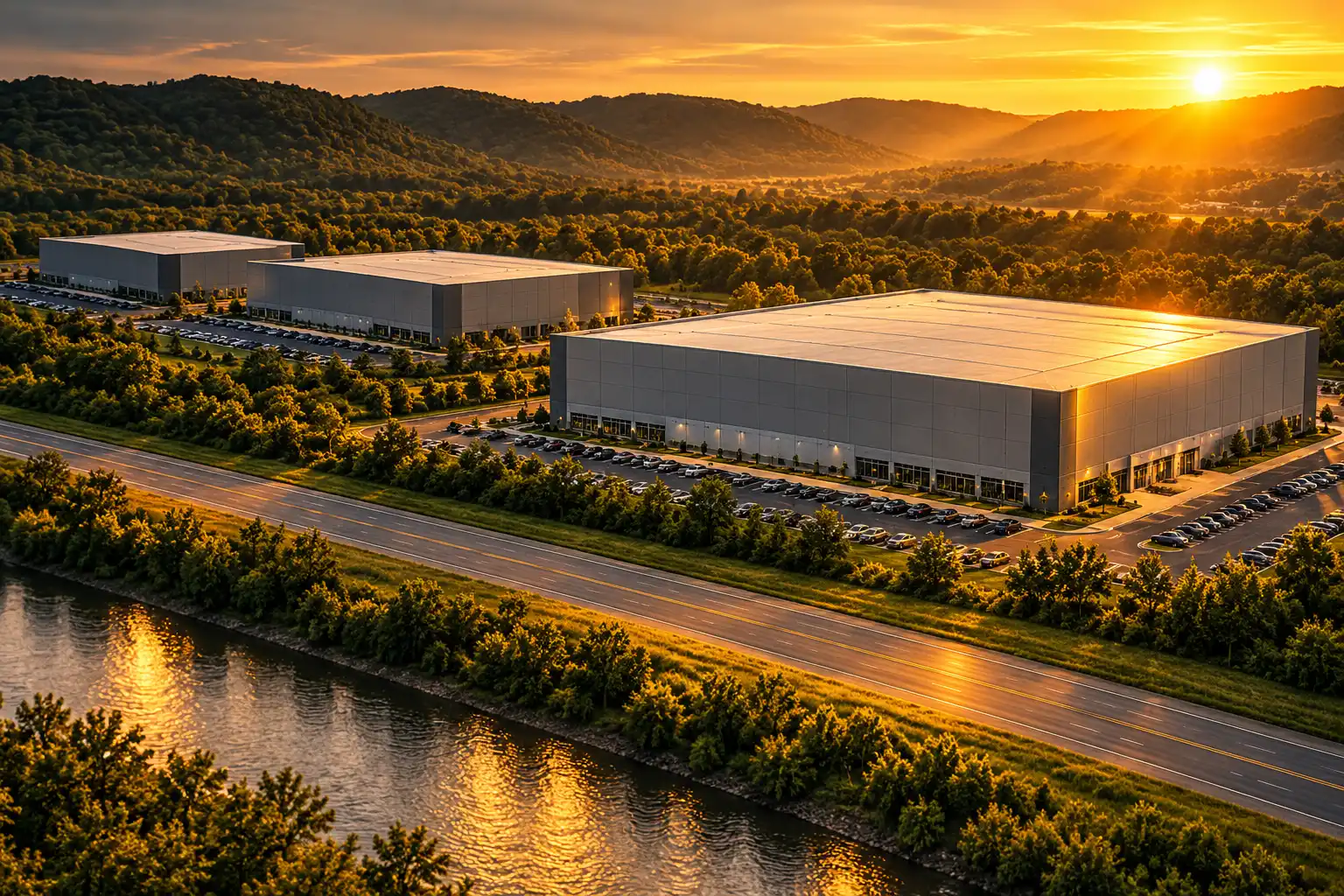
Monarch sits on more than 2,250 acres north of Point Pleasant. Nscale bought the site in March through American Intelligence & Power Corporation and markets it as the first state-certified AI microgrid in the United States, with a path past 8 gigawatts if later phases are built. Planned capital spending is more than $20 billion. Nscale also projects more than $80 million a year in West Virginia tax, including $40 million for Mason County schools.
The sales pitch is blunt, because the constraint everywhere else is electricity. Nscale says the campus generates all of its own power on-site, draws nothing from local utilities, and will not move local rates, a promise it says is backed by state law. Cooling is closed-loop, so the campus is not supposed to take municipal drinking water. Generators are to sit inside enclosures with mufflers, berms and sound walls.
MONARCH’S OFF-GRID CLAIMS
- On-site power: All campus load is generated behind the meter, with no draw on homes or businesses.
- Ratepayer shield: Nscale says project costs cannot be passed to local bills under West Virginia law.
- Gas plus batteries: Caterpillar G3500-series sets are paired with storage to ride the sharp swings of AI racks.
- Water: Closed-loop cooling is designed to leave the drinking-water system untouched.
- Scale: Phase 1 is 1.35 gigawatts of AI computing, aimed at early 2028, inside a campus Nscale says can grow past 8 gigawatts.
That design exists because waiting on a utility queue is how AI campuses die on paper. McKinsey has put 156 GW of AI data-center demand by 2030 against a build rate still gated by power, and Nscale cited that figure when it unveiled Monarch. In the UK, 315 data-center projects have sought 73 gigawatts of connections, against peak demand of 45 gigawatts. Mason County’s answer is a private gas plant sitting next to the halls it is meant to feed.
The Essex Anchor Left When the Grid Slipped
Microsoft terminated its agreement for Nscale’s Loughton site in Essex on October 18 and 19, after network operators told Nscale that enough power would not arrive until the early to mid-2030s. The hall had been sold as a 50-megawatt Azure AI site that could scale to 90 megawatts, with 23,040 Nvidia GB300 GPUs and a planned 2027 opening. Nscale had pledged £2 billion to the UK build. Microsoft had been the only named tenant.
A Microsoft spokesperson said the decision “relates to a single site.” The companies still list joint work in Norway, Portugal and the United States. Nscale said it is looking at on-site generation for Loughton and at other UK land, and it tried to ring-fence the rest of the Microsoft book.
Our relationship with Microsoft remains strong and long-term, and this unfortunate London-wide grid issue has no impact on our other contracts.
Nscale spokesperson, October 19, 2026
The prospectus, filed before the Essex exit, already records that OpenAI withdrew from the Stargate Norway and Stargate UK partnerships in April. Loughton is a small slice of Microsoft’s ceiling of up to $43.8 billion through December 2033. It is still the public example of what happens when a flagship hall is tied to a grid that cannot show up in this decade. Monarch is Nscale’s attempt to sell the opposite product, and Anthropic is the customer being asked to buy more of it.
$103.4 Billion of Contracts, 55 Megawatts Live
Nscale’s September 18 prospectus lists a total contract value of $103.4 billion as of August 31. Only $2.6 billion of that book was active, about 2.5 percent. Live power was 55 megawatts, all of it in Europe, with 48 megawatts in rented rooms and 7 megawatts at sites Nscale owns. About 25,000 GPUs were running against 461,000 active or contracted. First-half revenue was $140.6 million, up 1,252 percent from $10.4 million a year earlier, and the net loss was $1.02 billion.
Microsoft and Anthropic sit behind about 85 percent of the headline book. Microsoft’s statements of work, signed from September 2025 to April 2026, provide for payments of up to $43.8 billion through December 2033. Anthropic’s four August agreements provide for up to $44.6 billion at Monarch. The residual is about $15 billion, including a Figure AI order for up to 100,000 Vera Rubin GPUs from the second half of 2027.
NSCALE’S FILED CUSTOMER CEILINGS
| Customer | Ceiling | Where it sits | What is live |
|---|---|---|---|
| Microsoft | Up to $43.8 billion | Portugal, Norway and other sites through December 2033 | Part of the 55 MW now running; Loughton terminated |
| Anthropic | Up to $44.6 billion | Monarch, 460 MW of Vera Rubin NVL72 in four tranches | None; US capacity is still unbuilt |
| Rest of the book | About $15 billion | Figure AI and other customers | Folded into the $2.6 billion already active |
The shares are meant to trade on the New York Stock Exchange as NSCL. Nscale has not set a price range. Reported targets sit at $30 billion to $35 billion, against a $14.6 billion private mark in March. On September 25 it closed $3.36 billion of pre-IPO convertible notes, $2.36 billion up front and $1 billion from Nvidia due around November 16, in a package led by Third Point. Nvidia also sells Nscale its chips, buys capacity from it, and stands behind a Texas lease. Credit for specialist AI clouds is already tight, and another $45 billion of take-or-pay paper does not pour a pad or wire a turbine.
Anthropic Can Cancel a Late Tranche
The August Anthropic forms are take-or-pay only if Nscale actually delivers. If a tranche misses its window by a set period, Anthropic can end that tranche “without any payment or other obligation or liability of any kind,” the prospectus says. It can also tear up an agreement if monthly uptime stays below named floors for long enough. Prices, GPU counts and even the site name are redacted in the exhibit.
The same filing is blunt about cash. Nscale had to use best efforts to raise money for the GPUs and the halls, and as of the prospectus date it had “not obtained binding commitments for any of the financings required to fund performance under the Anthropic Services Agreements.” A second about $45 billion hall would land on that same unfunded stack unless new debt, the IPO, or Nvidia’s notes close the gap first.
On March 16, at Nvidia’s GTC event, Nscale announced a letter of intent with Microsoft for up to 1.35 gigawatts of AI compute capacity at Monarch, to be delivered in tranches from late 2027 on Vera Rubin NVL72 racks. That letter does not appear in the S-1. The named Monarch customer in the filing is Anthropic, at 460 megawatts. Josh Payne, Nscale’s chief executive, still has to turn both the letter and the Anthropic paper into halls that stay up.
Genset Deliveries Run Into 2027
The machines that make the off-grid pitch real are Caterpillar G3516 gas sets, ordered when AIP still owned the land. Deliveries are scheduled from September 2026 through August 2027, with 2 gigawatts of generation aimed at the first half of 2028. The sets are sold as fast-response units that ramp from zero to full load in seven seconds, then sit with batteries so an AI rack’s load spike does not brown out the hall. Boyd CAT, the local dealer, is on the service side. Caterpillar Financial is in the mix for equipment finance, on customary terms.
THE MONARCH CLOCK
- January 28, 2026: AIP, Caterpillar and Boyd CAT announce a 2 gigawatt G3516 order for Monarch, with deliveries from September 2026 through August 2027.
- March 16, 2026: Nscale buys AIP and the 2,250-acre campus and signs a Microsoft letter of intent for up to 1.35 gigawatts of Vera Rubin NVL72 capacity from late 2027.
- August 25, 2026: Anthropic signs four GPU service agreements worth up to $44.6 billion for 460 megawatts at Monarch.
- September 18, 2026: Nscale files to list as NSCL, showing $103.4 billion of contracts and 55 megawatts live, and no binding finance for the Anthropic build.
- September 25, 2026: Nscale closes $3.36 billion of pre-IPO convertibles, including $1 billion from Nvidia.
- October 18, 2026: Microsoft terminates the Loughton agreement after power for the Essex site is pushed into the 2030s.
- October 19, 2026: People close to the talks say Nscale is seeking a second about $45 billion Anthropic hall, another 460 megawatts, at Monarch.
Daniel J. Shapiro, who ran AIP and is now Nscale’s chief power officer, has described the site as a gas-and-battery plant built for AI racks rather than a hall waiting on a utility.
Our design is purpose-built for AI data center operations, combining fast-response natural gas generation with battery energy storage to manage rapid load variability and deliver consistent power quality at scale.
Daniel J. Shapiro, Chief Power Officer, Nscale, Caterpillar alliance announcement
People close to the talks said details of a second hall can still change. Nscale and Anthropic have not confirmed a new contract, and the first Anthropic tranches still need finance, turbines and a late-2027 switch-on before any second 460-megawatt building is more than a term sheet.
Disclaimer: This piece is news reporting and analysis of company statements, a filed prospectus and talks that have not been confirmed as a signed contract. It is informational only and is not investment advice, a solicitation, or a recommendation to buy or sell securities of Nscale, Anthropic, Nvidia, Microsoft, Caterpillar or any related vehicle. Readers should consult a licensed financial adviser, and where needed a securities lawyer, before acting on any IPO, convertible note, take-or-pay contract or data-center claim. Contract ceilings, live megawatts, delivery dates and talk terms come from the September 18 prospectus and from dated company statements, and they can move if filings are amended, talks fail or power slips.

A 16GB Gaming GPU Now Runs a Three-Model Homelab

Nscale Pushes Anthropic Toward a Second $45 Billion Hall

The WordPress GPL That Makes Nulled Plugins Look Legal

WVU Parkersburg Builds Its Cloud Degree Around Employer Bills

Utho Asks India to Book B300 GPUs Before They Arrive
Utho Asks India to Book B300 GPUs Before They Arrive

Rank Math PRO Joined a 2026 Pattern of Paid Plugin Backdoors

GoDaddy Lets AI Agents Run Hosting, Email and Stores

Elementor Pro’s Form Bug Left Hosts Holding the Cleanup

FirstVDS Disk Theft Exposes a Live VMmanager Flaw
-
 Cloud Hosting4 weeks ago
Utho Asks India to Book B300 GPUs Before They Arrive
-
 NEWS1 month ago
Rank Math PRO Joined a 2026 Pattern of Paid Plugin Backdoors
-
 AI1 month ago
GoDaddy Lets AI Agents Run Hosting, Email and Stores
-
 NEWS1 month ago
Elementor Pro’s Form Bug Left Hosts Holding the Cleanup
-
 NEWS4 weeks ago
FirstVDS Disk Theft Exposes a Live VMmanager Flaw
-

 Email Hosting1 month ago
Windows Updates Cap RPC Calls and Stall Exchange Mail
-

 Cloud Hosting1 month ago
Yandex Cloud Bots Moved to Selectel After the Strikes
-

 Email Hosting1 month ago
Titan Puts a $3 Inbox Beside Google on Squarespace